PHOENIX (AP) — Hot and cold extremes are expected this week in the U.S. Officials warned residents from coast to coast to take precautions as a heat wave moved east, while heavy rains and flooding could drench the Gulf states and snow threatens parts of the Rockies and Northwest.
Extreme heat spread across Arizona, New Mexico and parts of Texas, Colorado and Kansas as severe weather swept across many parts of the U.S. on Sunday. There was unseasonable cold in the Pacific Northwest, snow headed to the northern Rocky Mountains and heavy rainfall forecast from the northern Plains to the Upper Midwest.
The National Weather Service estimated more than 63 million people were under heat advisories on Sunday, stretching from the Southwest northward up through Denver and into Chicago. Much of the Midwest and Northeast were under heat warnings or watches on Monday.
The National Weather Service in Pittsburgh issued a heat advisory for Westmoreland and Fayette counties through June 21.
The high Tuesday in the Fay-West area is expected to reach 94 degrees with a 30 percent chance of thunderstorms.
Wednesday’s high should reach 93 degrees and be hot. Thursday’s temperatures are expected to reach 96 degrees and the same is expected for Friday and Saturday.
Temperatures in Phoenix, which hit 112 degrees Fahrenheit on Saturday, eased slightly on Sunday to 110 degrees Fahrenheit.
Weather service forecasters say the first two weeks of June in Phoenix already have been an average of 5.6 degrees Fahrenheit hotter than normal, making it the hottest start to June on record.
“We have already seen some pretty significantly high temperatures in our area,” said Ted Whittock, a meteorologist with the National Weather Service in Phoenix.
“We are recommending that everyone reduce their time outdoors between 10 a.m. and 6 p.m., stay hydrated and wear light, looser fitting clothing.”
The heat in metro Phoenix will ease a bit Monday through Wednesday, with the highs pushing back up as the week progresses, likely prompting another excessive heat warning, Whittock said.
The heat has been especially dangerous in recent years in metro Phoenix, where 645 people died from heat-related causes in 2023, which was a record.
The city and Maricopa County have adopted additional measures this year in hopes of keeping people safer, including two new overnight cooling centers where people can rest in air conditioning after the sun goes down.
There are more than 100 other cooling centers that have been open since May 1 where people can get cold water and sit in a cool space during daytime hours.
In neighboring New Mexico, a heat advisory was in effect over the weekend for the Chavez County plains including Roswell, where the high was forecast to hit 107 degrees F on Monday. The high for Albuquerque reached 99 degrees F on Sunday and is forecast to cool slightly to 98 degrees F on Monday.
The high Sunday was 104 F in El Paso, Texas, which opened five cooling centers.
Temperatures in Colorado ranged from near 90 degrees F in areas of metropolitan Denver Sunday to 100 degrees F in the southern city of Pueblo, with temperatures expected to surpass 100 degrees F Monday in the southern reaches of the state.
The heat wave was moving eastward Sunday into the Plains and the Great Lakes area and was expected to arrive in the Northeast by Tuesday.
The threat of thunderstorms with potential high winds and heavy rainfall increased in the Chicago area, even as heat indices were forecast to reach near 100 degrees F through the middle of the week.
As the heat wave spreads eastward, temperatures in Washington, D.C., and the rest of the mid-Atlantic, as well as New England, were likely to see highs in the mid- to upper-90s as the week progresses, with excessive humidity making it feel even more oppressive.
The U.S. last year saw the most heat waves, consisting of abnormally hot weather lasting more than two days, since 1936.
While much of the country swelters, late season snow was forecast for the northern Rockies Monday and Tuesday. Parts of Montana and north-central Idaho were under a winter storm warning, with as much as 6 inches of heavy, wet snow expected in the mountains around Missoula, Montana. As much as 20 inches was predicted for higher elevations around Glacier National Park.
Meanwhile, a fresh batch of tropical moisture will bring an increasing threat of heavy rain and flash flooding to the central Gulf Coast late Sunday into Monday. Heavy rain is expected to start Monday morning, with the moisture shifting toward the Gulf Coast by Tuesday.
The intense flooding from heavy rains continued to dissipate in southern Florida, where some areas in and around Miami and Fort Lauderdale were left underwater in recent days as storms dumped up to 20 inches.
That unnamed storm system coincided with the early start of hurricane season, which this year is forecast to be among the most active in recent memory.
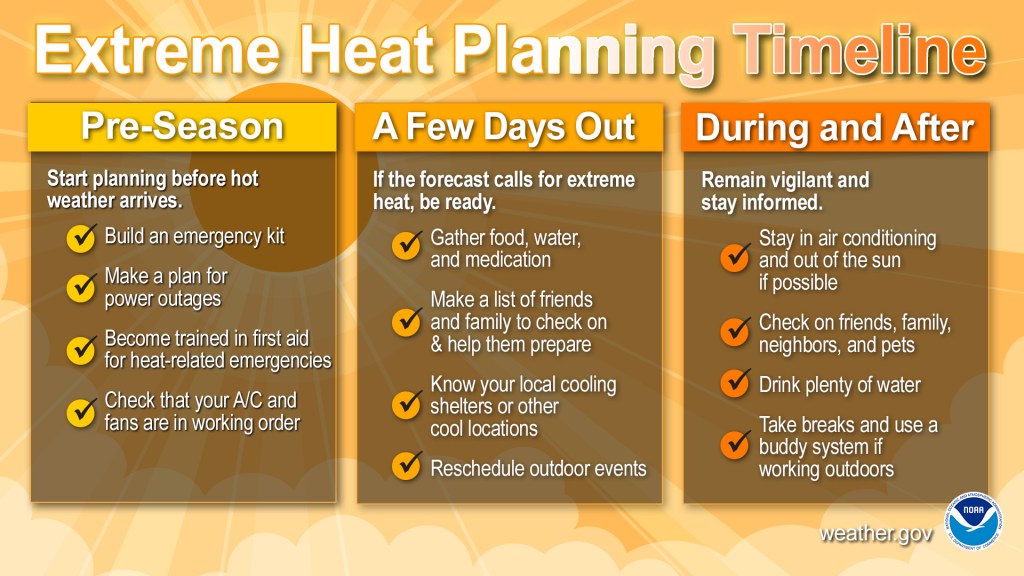
To help prepare you for hotter temperatures, here are three ways to stay safe this summer.
Choose the right sunscreen
To ensure adequate protection from the sun’s harmful rays, it is important to choose a sunscreen that offers both UVA and UVB protection. This will protect your skin from the effects of ultraviolet-B (UVB) rays, such as sunburns and skin damage, as well as ultraviolet-A (UVA) rays that can increase the risk of skin cancer.
“Look for sunscreens that contain zinc oxide or titanium dioxide as these ingredients block both types of rays, said John A. Holets, MD, a physician with Penn Highlands Family Medicine in Monongahela.
Be sure to choose a sunscreen with an SPF of 30 or higher too. And remember that just because a sunscreen has a higher SPF doesn’t mean higher protection. SPF protection does not increase proportionately with the SPF number. SPF 30 absorbs 97% of the sun’s rays, while SPF 50 absorbs just 1% more. Choose anything over 30 SPF, apply liberally and reapply every two hours.
Drink plenty of fluids
You should be drinking plenty of water all year long, but especially in the hot summer months. Drink fluids throughout the day, regardless of how active you are, and do not wait until you are thirsty to drink.
“The type of liquid you drink also matters,” said Dr. Holets. “Sugary drinks can actually cause your body to lose fluids, and very cold drinks can cause stomach cramps.”
Heavy sweating depletes much-needed minerals and salt from your body, and a sports drink can replace these nutrients. When choosing a sports drink, look for a low-sugar option.
Know the symptoms of heat-related illness
High heat and humidity or prolonged exposure without relief or adequate fluid intake can cause heat-related illness. There are three types: heat cramps, heat exhaustion and heat stroke.
Heat cramps are often the first sign of a heat-related illness, and it may lead to more severe illnesses, such as heat exhaustion or stroke. Symptoms of heat cramps include painful muscle cramps and spasms, usually in legs and abdomen as well as heavy sweating. If you experience these symptoms, apply firm pressure on cramping muscles or gently massage to relieve spasms. You can also take sips of water, but if you feel nauseous, stop drinking. If cramps last longer than one hour, seek immediate medical attention.
Symptoms of heat exhaustion include heavy sweating; weakness or tiredness; cool, pale, clammy skin; fast, weak pulse; muscle cramps; dizziness, nausea or vomiting; headache; and fainting. If you suspect heat exhaustion, move to a cooler environment, remove tight-fitting clothing and apply cool, wet clothes to the skin. Seek immediate medical attention if you vomit or symptoms worsen or last longer than one hour.
Heat stroke is the most severe heat-related illness. It is a life-threatening emergency and requires immediate medical attention. Symptoms include throbbing headache; confusion; nausea; dizziness; body temperature above 103°F; hot, red, dry or damp skin; rapid and strong pulse; fainting; and loss of consciousness. If you or a loved one is experiencing these symptoms, call 9-1-1. While waiting for emergency personnel, move to an air-conditioned area and reduce body temperature by applying cool cloths or a bath. Do not give fluids to a person experiencing symptoms of heat stroke.
Summer is a great time for being outdoors but too much sun and or heat exposure can require medical attention. While heat exhaustion and heat stroke require immediate attention, people with severe sunburns may need to see a physician or provider.
 Dustin's Dynasty
Leave a comment